
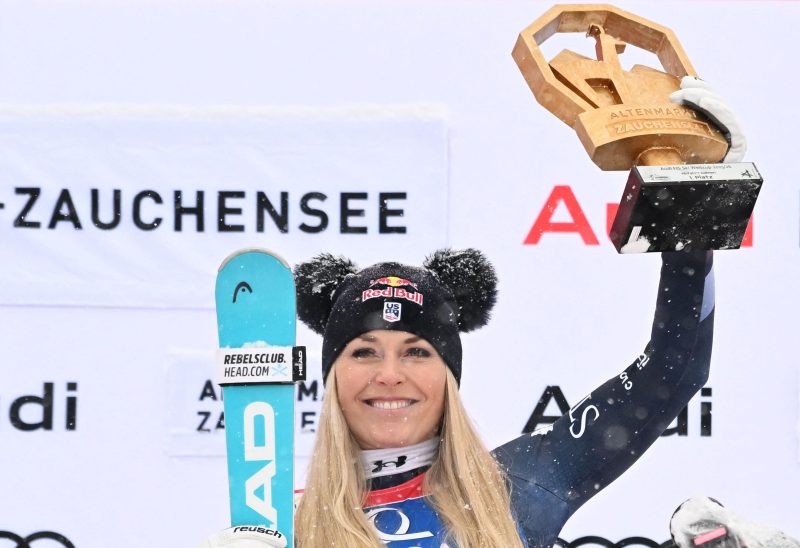
Lindsey Vonn is determined to compete in the 2026 Winter Olympics despite rupturing her ACL on Jan. 30.
Vonn’s comeback at age 41 follows a 2019 retirement and a 2024 partial knee replacement.
Despite her recent injury, Vonn remains confident in her ability to compete, citing her past experiences with overcoming setbacks.
She’ll be holding tight to her fierce self-belief at these Olympics, as she tries to do something others think is impossible. Or crazy.
CORTINA D’AMPEZZO, Italy — The strongest part of Lindsey Vonn is not her legs or her core or even that titanium that’s now in her right knee.
It’s her belief in herself, as fierce as it is unshakable. She will need that now, maybe more than ever. Despite a left knee shredded and an ACL torn in a crash on Jan. 30, Vonn is determined to compete in one final Olympics, to see through a comeback that was already nothing short of amazing.
‘As many times as I crash, I’ve always gotten back up. As many times as I’ve failed, I’ve always won,’ Vonn said Tuesday, Feb. 3. ‘So actually, all of my experience in my life has given me a lot of confidence in knowing what my body can and cannot do.
‘I’ve been in this position before. I know how to handle it. I’ve been on the world stage before. I know how to handle that,’ she added. ‘So, everything together, even though I don’t want to be in this position, I know how to be in this position, and I can handle it.’
Get our Chasing Gold Olympics newsletter in your inbox for coverage of your favorite Team USA athletes
Even before the crash, which occurred in the final World Cup downhill before the 2026 Winter Olympics in Milano Cortina, Vonn’s comeback has been one of the most incredible stories in sports history. It’s not just that she is 41 years old, or that she resumed her career after being retired for almost six years. It’s not even that she’s doing this with a partial knee replacement, uncharted territory for a world-class ski racer.
It’s that, despite all that, Vonn has been dominant, as good now as she’s ever been.
She’s been on the podium in every downhill race this season, winning two of them, and has been in the top three of two of the three super-G races she did. She leads the downhill standings and is sixth in the overall race.
“Everyone told me I couldn’t,” Vonn said. “I knew what I was capable of doing, and I showed the world that I could.”
It’s that refusal to accept less than what she believes she can do that is driving Vonn now. She knows she is not the gold-medal favorite in Cortina she would have been last week. She knows she might not even contend for a medal.
But she also believes she can make it to the starting gate for Sunday’s downhill. And that is reason enough to try.
‘I feel a lot better right now than I did in 2019 for the last world championships,’ Vonn said, referring to the torn LCL she had in her left knee then, ‘and I still got a medal there.’
A life of pain
This was not the comeback Vonn envisioned when she had her partial knee replacement in April 2024. She didn’t envision a comeback at all then.
Vonn did not have her partial knee replacement because she didn’t know what else to do with herself or because she was seeking some glorious second act and the spotlight that would come with it. She had built a full life in retirement, working with her foundation and sponsors, investing, traveling and trying all the things she could never do when she was competing.
But she was also in extraordinary pain.
Vonn’s right knee was in such shambles she felt as if she was walking on Rice Krispies every time she took a step. Snap. Crackle. Pop. And those activities she was finally doing? It’s hard to fully enjoy them when you’re gritting your teeth the entire time.
The knee replacement was so Vonn could be active like anyone else. Well, as active as anyone who wants to try rodeo and kite surfing and driving a race car.
“When you’re a professional athlete, you sacrifice a lot of things that you would like to do because it’s too dangerous or it’s going to make you tired and you have to set certain priorities in your life,” Vonn said. “I waited a long time to do all these things and I couldn’t really do them. I did them, but it was very painful.
“So when I did the surgery, it was literally just to live a pain-free life.”
During the procedure, orthopedic surgeon Martin Roche removed the cartilage and bone from the outside of Vonn’s right knee and replaced it with titanium. Her ACL and medial meniscus remained intact, as did the cartilage on the inside of her knee, which maintained the joint’s “feel.”
Within days, Vonn knew things were different. She’s had plenty of surgeries before — at least nine on her knees alone — and had never felt this good during recovery. She could bend and straighten her knee, something she hadn’t been able to do in a decade. She could push herself in the gym and not pay the price later that day or the next.
As she sped through recovery, she began toying with the idea of a comeback.
“I retired in 2019 because my body said no more,” Vonn said, “not because I didn’t want to continue racing.”
A second act
After getting clearance from her doctors, Vonn resumed training. The reaction, from some, was downright hostile.
“Lindsey is a grande dame of the sport, but for me, she can only lose with this comeback,” Sonja Nef, the giant slalom world champion in 2001, told Blick.ch in November 2024. “It feels like she’s jeopardizing her legacy.”
The comments were, of course, hurtful. Coupled with mixed results in her first season back, Vonn acknowledges her self-confidence took a hit.
But that’s the beauty of being a woman in her 40s who’s been through some things. Vonn had both the perspective and self-awareness to withstand the negativity. No matter what anyone said, Vonn knew she was always going to be the 2010 Olympic downhill gold medalist, a four-time overall champion and No. 3 on the career World Cup wins list.
No matter what happened in her second act, she’d already won.
“I’m not skiing to prove anything to anyone,” Vonn said. “That time away just made me realize, ‘OK, I’ve done everything I ever set out to do.’ This is something different. This is a separate journey that I’m taking. It’s not really connected to — I feel like my first career. I feel like this is its own chapter in my book of life, and it’s very special for many reasons.”
Get Olympics updates in your texts! Join USA TODAY Sports’ WhatsApp Channel
Back on the podium
That doesn’t mean Vonn was just happy to be racing again. She is, after all, Lindsey Vonn. If she’s going to race, she’s going to do it right.
That’s what made last season so frustrating. Because she hadn’t had much training time before the World Cup season began, Vonn was constantly trying to fine-tune her equipment on the fly. Her skis were fine, but her boots were another story.
The model had changed during her retirement. Though they initially felt fine and Vonn trained well in them, she wasn’t skiing fast on race day.
“And I could not figure out why,” Vonn said. “Everyone else skis with the same boot and everyone else is fast, but I was not fast.”
She finally went back to her old model — “which was collecting dust in the basement” — about three-quarters of the way through the season. She could feel a difference immediately.
Then, at the World Cup finals in Sun Valley, Idaho, Vonn was second in the super-G.
“I knew that I could compete,” Vonn said. “I knew the way I felt on my skis, and I never stopped believing in that.”
Everything comes together
In addition to getting her boots figured out, Vonn convinced two-time overall World Cup champion Aksel Lund Svindal to join her coaching staff. The two had raced at the same time — they both retired after the 2019 world championships — and Vonn knew he could help her.
“(At) inspection, he knows the line that men ski and that’s the type of edge that I need. I need to be able to push the limits in a way that the other women are not willing to,” Vonn said. “He knows what I’m capable of because he’s been in that exact same position.”
Svindal was already watching Vonn’s races when she called to recruit him, and he had ideas of where she could get more speed. Specifically, the flat portions of the course.
Everyone thinks Vonn is best when she’s gliding. But Svindal said it’s her turns that are the former slalom skier’s superpower.
“The more power you can pull in the turns, the faster she is,” he said. “So if we can make you as good as the rest of the field in gliding, you will pull away in the turns. That’s why you won all those races.”
Vonn felt good going into this season, but you never really know until the races begin.
She won the first downhill, finishing almost a second ahead. The next day, in another downhill, she was second.
Vonn’s comeback was all the way back.
“All the people that didn’t believe in me, I have to thank them because it really gives me a lot of motivation,” Vonn said at weekend. “I’m surprised that people haven’t figured that out by now. Every time you talk bad about me, it just makes me stronger and better and more motivated.”
It doesn’t matter if others believed in her. Vonn believes in herself, and that’s more than enough.
She’ll be holding tight to that faith at these Olympics, as she tries once again to do something others think is impossible. Or crazy.
‘I will make it to the starting gate,’ she said. ‘It’s already been one of the best chapters of my life so far. I think this would be the best comeback I’ve done so far. Definitely the most dramatic, that’s for sure.’
Follow USA TODAY Sports columnist Nancy Armour on social media @nrarmour.