
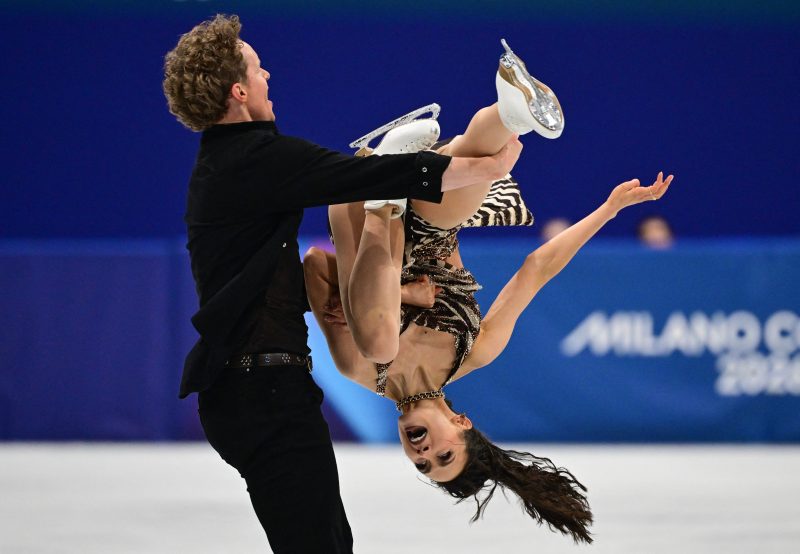
MILAN — With the figure skating team event complete and Team USA winning gold, ice dance took center stage at the 2026 Winter Olympics on Monday with the rhythm dance.
Team USA’s top pair of Madison Chock and Evan Bates finished the session in second behind Laurence Fournier Beaudry and Guillaume Cizeron of France. Now, they’ll have to come from behind in the free dance on Feb. 11 to win gold.
Follow USA TODAY Sports for the results and highlights from the ice dance rhythm dance.
Watch Olympic figure skating on Peacock
Rhythm dance figure skating live results, updates
Here are the final rhythm dance standings. The free dance is Feb. 11, after which the medals will be decided.
Laurence Fournier Beaudry and Guillaume Cizeron (France): 90.18 total segment score, 51.94 technical elements score, 38.24 program components score.
Madison Chock and Evan Bates (United States): 89.72 total segment score, 51.54 technical elements score, 38.18 program components score.
Piper Gilles and Paul Poirier (Canada): 86.18 total segment score, 49.41 technical elements score, 36.77 program components score.
Lilah Fear and Lewis Gibson (Great Britain): 85.47 total segment score, 49.03 technical elements score, 36.44 program components score.
Charlene Guignard and Marco Fabbri (Italy): 84.28 total segment score, 47.83 technical elements score, 36.45 program components score.
Emilea Zingas and Vadym Kolesnik (United States): 83.53 total segment score, 48.27 technical elements score, 35.26 program components score.
Allison Reed and Saulius Ambrulevicius (Lithuania): 82.95 total segment score, 47.86 technical elements score, 35.09 program components score.
Evgeniia Lopareva and Geoffrey Bruissaud (France): 82.25 total segment score, 46.83 technical elements score, 35.42 program components score.
Marjorie Lajoie and Zachary Lagha (Canada): 79.66 total segment score, 45.41 technical elements score, 34.25 program components score.
Olivia Smart and Tim Dieck (Spain): 78.53 total segment score, 44.52 technical elements score, 34.01 program components score.
Christina Carreira and Anthony Ponomarenko (United States): 78.15 total segment score, 44.34 technical elements score, 33.81 program components score.
Juulia Turkkila and Matthias Versluis (Finland): 77.96 total segment score, 44.38 technical elements score, 33.58 program components score.
Diana Davis and Gleb Smolkin (Georgia): 77.15 total segment score, 43.23 technical elements score, 33.92 program components score.
Natalie Taschlerova and Filip Taschler (Czechia): 75.33 total segment score, 43.07 technical elements score, 32.26 program components score.
Marie-Jade Lauriault and Romain le Gac (Canada): 74.35 total segment score, 42.38 technical elements score, 31.97 program components score.
Phebe Bekker and James Hernandez (Great Britain): 72.46 total segment score, 41.63 technical elements score, 30.83 program components score.
Katerina MRazkova and Daniel Mrazek (Czechia): 72.09 total segment score, 40.50 technical elements score, 31.59 program components score.
Holly Harris and Jason Chan (Australia): 67.75 total segment score, 37.78 technical elements score, 29.97 program components score.
Milla Ruud Reitan and Nikolaj Majorov (Sweden): 67.31 total segment score, 37.71 technical elements score, 29.60 program components score.
Sofia Val and Asaf Kazimov (Spain): 64.98 total segment score, 35.87 technical elements score, 29.11 program components score.
Shiyue Wang and Xinyu Liu (China): 64.76 total segment score, 36.36 technical elements score, 28.40 program components score.
Hannah Kim and Ye Quan (Korea): 64.69 total segment score, 34.28 technical elements score, 30.41 program components score.
Jennifer Janse van Rensburgh and Benjamin Steffan (Germany): 63.76 total segment score, 33.66 technical elements score, 30.01 program components score.
French figure skating pair make statement
The bar has been set in the rhythm dance. The French pair of Laurence Fournier Beaudry and Guillaume Cizeron have officially put themselves in the medal conversation with a season-best 90.18 in their “Vogue” program.
They are considered a major opponent to Chock and Bates, and this confirms the Americans will need a big showing in the free dance to keep their gold hopes alive.
When do Chock and Bates skate next?
Chock and Bates will skate four times in six days at these Olympics. They competed in the rhythm dance and free dance of the team event. Now, they move to the ice dance competition. They skated their rhythm dance on Feb. 9, and will skate their free dance on Feb. 11.
Chock and Bates Olympics medals
Chock and Bates have won gold already at the 2026 Winter Olympics — in the team event — as they did at the 2022 Games. Now they go for gold in ice dance, the one medal that is missing from their careers.
Chock and Bates free dance 2026
Chock and Bates performed their free dance in the figure skating team event on Feb. 7 and will skate it again on Feb. 11.
Are Madison Chock and Evan Bates dating?
They are married. The duo began skating together 2011 before they became a couple in 2016 and getting married in 2024.
Why Madison Chock and Evan Bates face greatest challenge yet
Chock and Bates by far have the most challenging schedule of any figure skaters in the Games: Four programs in six days, including back-to-back duty in the team event on Feb. 6 and 7. Now, they have 48 hours until the ice dance competition opens Feb. 9 with the rhythm dance and concludes on Feb. 11 with the free dance. Their performances in the team event set up Team USA for its second straight gold medal.
But the most decorated ice dance pair in U.S. figure skating history wants more than a team medal in Milan — they want the ice dance gold medal, the one achievement they’ve been chasing for years. But while they did so much heavy lifting for their team, their competition got extra rest.
US figure skating team
Men: Ilia Malinin, Maxim Naumov, Andrew Torgashev
Women:Amber Glenn, Alysa Liu, Isabeau Levito
Pairs: Ellie Kam and Danny O’Shea; Emily Chan and Spencer Akira Howe
Ice dance: Madison Chock and Evan Bates; Emilea Zingas and Vadym Kolesnik; Christina Carreira and Anthony Ponomarenko
How ice dancing works
A male skater and female skater can perform spins and lifts, but cannot otherwise leave the ice. That means there are no jumps or throws, like pairs skating. The performance is judged on rhythm, footwork and choreography. The event consists of a rhythm dance and free dance.
When was figure skating added to Winter Olympics?
Figure skating first made its Olympic debut at the Summer Games in London in 1908 and made another appearance in Antwerp in 1920, before becoming a Winter Olympic staple at the inaugural 1924 Chamonix Winter Games with men’s singles, women’s singles and pair skating events. Ice dancing was added to the program at the 1976 Innsbruck Winter Olympics, and the team event was first contested at the 2014 Sochi Winter Olympics.
What time is figure skating on today?
The rhythm dance begins at 1:20 p.m. ET and runs through 5 p.m. ET.
Why Team USA’s figure skates had to get fixed
U.S. skaters had their skates messed up after the medal ceremony on Sunday, and needed to get them fixed, a person with knowledge of the situation told USA TODAY Sports.
The issue was a result of the medal podium, as it was not covered in carpet or a similar soft surface, the person said, leading to scratches and potential damages to the skates.
Typically, skaters put on skate guards whenever they are not on the ice to prevent damage. All the medalists came onto the ice for the medal ceremony, but there were not skate guards for them to put on when they stepped on the podium, leaving them without a chance to protect the blades.
Team USA did do a jump on the podium.
What is difference between ice dancing and figure skating?
Ice dancing does not feature jumps or lifts, like you see figure skating pairs execute. Ice dancing is made up of two segments, the rhythm dance and the free dance.
Olympics figure skating schedule
Figure skating at the Olympics rolls on Monday with the start of the ice dance competition. The men’s singles event starts Feb. 10 with the short program and concludes on Feb. 13 with the free skate. The pairs competition is Feb. 15-16. The women’s singles opens Feb. 17 with the short program and wraps Feb. 19 with the free skate.
Meet US ice dance pair Christina Carreira and Anthony Ponomarenko
Age: Carreira is 25, Ponomarenko is 24
Height: Carreira is 5-5, Ponomarenko is 5-11
Hometown: Carreira is from Saint Clair, Michigan; Ponomarenko is from San Jose, California
Olympic experience: First
Event: Ice dance
What to know: Even with a crowded field, Carrerira and Ponomarenko have remained consistent figures in the ice dance. They’ve been in the top five of every event they’ve done since 2024, and they’ve placed in the top five of the past four U.S. championships, including two second place finishes. Their selection to this Olympics team comes right on time as Carreira, a Canada native, obtained her American citizenship in November. Before then, they would drive across the Canada-U.S. border every day for practice.
Figure skating jump types
Toe jump: A skater drives the toe pick of their non-takeoff foot into the ice to launch themselves into the air and generate momentum into the jump.
Toe loop: A skater takes off backward and lands on the same back edge of their blade.
Lutz: A skater moving backward jumps off the back outside edge of their skate and uses the toe-pick of their other skate to catapult into the air in the opposite direction and lands on the back outside edge of the picking leg.
Flip: A skater launches off the back inside edge of one skate and lands on the back outside edge of the other skate.
Edge jump: A skater takes off not with their toe pick but off the edge of their skate.
Salchow: A skater launches off the back inside edge of one skate and lands on the back outside edge of their other skate.
Axel: The only forward-facing jump, a skater lands on the back outside edge of their non-takeoff foot while traveling backward. The axel is the hardest jump because of the extra half-revolution that comes with a forward takeoff and a backward landing.
Loop: The skater jumps off a back outside edge of their skate and lands on the same edge.
How is figure skating scored?
A figure skating routine is made up of two scores: Technical elements score and program components score. The technical elements score is exactly what it sounds like: It’s for the jumps, spins and step sequences in a performance. The program components score is made of up composition, presentation and skating skills.