
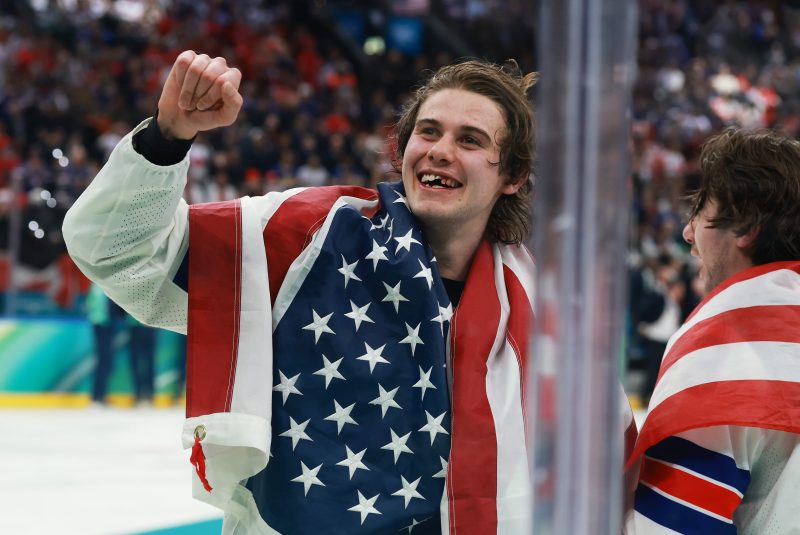
When Team USA general manager Bill Guerin named the U.S. Olympic men’s ice hockey team on Jan. 2, the second guessing began.
It was mostly the 4 Nations Face-Off team, which was impressive but lost to Canada in the final. There were a few others, such as Quinn Hughes, who had been named to last year’s team but couldn’t go because of an injury.
Tage Thompson was a welcome addition, as was Clayton Keller. But why were big-time scorers Cole Caufield, Jason Robertson and Lane Hutson left off while J.T. Miller and Vincent Trocheck of the struggling New York Rangers were brought back?
Guerin said he was building a hockey team, not an All-Star team.
Well, he was right. The United States won its first gold medal since 1980, beating Canada 2-1 in overtime, completing an impressive year for USA Hockey’s top national teams. There was a women’s hockey gold, also against Canada, a men’s and women’s world championship and a sweep of the women’s Rivalry Series.
Here are the winners and losers of the men’s hockey tournament at the 2026 Winter Olympics:
WINNERS
Jack Hughes, USA
The Devils star had to overcome so much to play in the Olympics. He rehabbed from last year’s season-ending shoulder surgery, had a freak accident at a team dinner that required finger surgery and also missed games leading into the Olympics. He joined brother Quinn in Milan, made sweet passes in the Latvia win, scored twice against Slovakia and had the golden goal against Canada. Naturally, he did it after an injury, getting high sticked and losing a tooth in the third period.
Auston Matthews, USA
The inability of the Toronto Maple Leafs to get far in the playoffs has led the city’s tough hockey media to question the team’s stars, including captain Matthews. Well, Matthews was named the USA’s captain, just as in the 4 Nations, and he now can respond that he can lead a team to victory.
Connor Hellebuyck, USA
Last year, he won the Vezina Trophy and got a rare goalie Hart Trophy win. But he was pulled in three games on the road against the St. Louis Blues in the playoffs. Can’t win a big game? Well, the USA doesn’t win on Sunday without Hellebuyck, who made 41 saves.
Sending NHL players to the Olympics
The hockey was great, especially in the quarterfinals, when three games went to overtime. But the best was the gold medal game. Canada pressed and looked like it was going to rally and win for the third game in a row. But the USA eventually prevailed against a heated rival. Best on best is the best way to do the Olympics.
WINNER AND LOSER
Connor McDavid, Canada
The 4 Nations overtime goal scorer had an impressive tournament and was named MVP after scoring 13 points, a record by an NHL player at the Olympics. But the award was bittersweet because Canada won silver, not gold. It’s the second time he was given an individual prize when his team came in second. He was voted the Conn Smythe Trophy as playoff MVP in 2024 after the Edmonton Oilers lost Game 7 of the Stanley Cup Final to the Florida Panthers.
LOSERS
Sidney Crosby missing the final
When the Canada-USA game went to overtime, it brought back memories of Sidney Crosby’s golden goal in 2010. No chance of that, though. The Canadian captain was injured in the quarterfinals, when he was hit hard twice. He missed the semifinals and couldn’t make the final and try to win his third gold medal. And now the Pittsburgh Penguins will have to figure out if he’ll miss part of the stretch run.
Los Angeles Kings
They made the big trade for Artemi Panarin and were looking for him to boost their offense enough to get back in the playoff hunt. But now they suffered a setback because Kevin Fiala broke his leg in a loss to Canada, had surgery and will miss the rest of the regular season. NHL owners are concerned about players getting hurt at the Olympics and it happened in varying degrees to Fiala, Crosby, Josh Morrissey and Mikko Rantanen.
Pierre Crinon, France
He delivered a questionable hit on Nathan MacKinnon, leading to a scrap with Tom Wilson. The International Ice Hockey Federation prohibits fighting and could have suspended him, but it didn’t. The French team did, though, saying: ‘Pierre Crinon’s provocative behavior when he came out of the ice, even though he had just been excluded from the match for a fight, is a clear violation of the Olympic spirit and also undermines the values of our sport.’
3-on-3 overtime
There were four overtimes in the knockout round and theoretically, they could have lasted 10 minutes, and 20 minutes or longer in the gold medal game. But the longest overtime was 3 minutes, 27 seconds. That’s because of 3-on-3 play in overtime. The NHL uses it in the regular season but switches to 5-on-5 in the postseason. That’s because it knows a crucial game shouldn’t be decided by something gimmicky. The IIHF should rethink its position for the 2030 Olympics.