
This week:Using sports to find a life path for success.
Read Part I: How college recruiting can be like the dating game
Read Part II: A ‘broken’ system? Negotiating constant change in college sports
PHILADELPHIA — Are you a late bloomer?
Maybe you weren’t a Little League All-Star, or didn’t make the A squad on the town soccer, lacrosse or basketball team.
You might be exactly what your future college coach wants.
“Think about that cup being half full,” says Ray Priore, 62, who spent more than half his life on Penn football’s coaching staff. “That’s when you want to get somebody. Because when you get them here, you can get them bigger, stronger, faster, and that’s development.
“If there’s an art to recruiting, and there is, (it’s) how do you see who those kids are?”
Penn’s four best players this past season, according to Priore, were guys who distinguished themselves in their senior years of high school, two of them in an extra year at a college preparatory school.
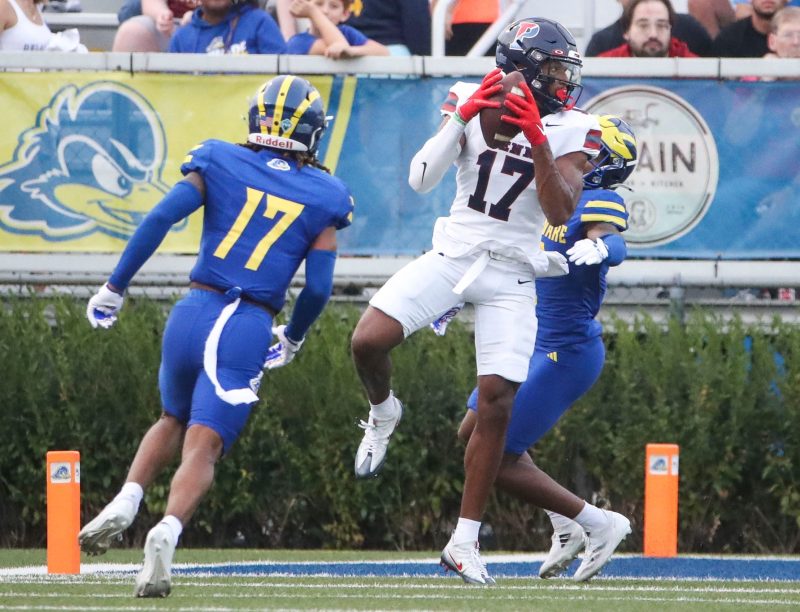
Star wide receiver Jared Richardson was a quarterback, but Penn’s coaches loved the athleticism he showed with the ball in his hands. Bisi Owens, the team’s second-leading receiver, could have played QB in college but wound up at Penn because Priore loved how he played above the rim in basketball.
Priore saw how Liam O’Brien, the 2025 starting QB, and Alex Haight, another wide receiver, matured during a fifth year at the Deerfield Academy in Massachusetts.
“My angle on it is you go out early, fill your class, but are you taking just to take to fill the class? Or are you taking the best players?” Priore says.
“And I do believe there is such a huge development part that’s missing and why there are still good players out there right now to go recruit.”
Priore spoke a few days before he stepped down on Nov. 24 following 11 seasons as head coach. He left with this parting shot: Coaches, even at the Division I level, will keep their eyes open for players who show late bursts of maturity.
If a D-I coach doesn’t find you, maybe it will be someone in Division III like Jerheme Urban of Trinity University, who seeks a similar profile of freshmen who shoot for the Ivy League.
Urban wants kids he can develop, of course, into winners on the football field but also ones who take a long view of what they can get out of a collegiate sports experience.
What’s the purpose of college sports? Really, at any level you achieve, you can look at it as your transition into the real world.
Kids, even late in high school, get better with age. Give them time to develop.
To Priore, the lesson was the same, whether you were the player scouted by the NFL or the walk-on who became captain: Can you get knocked down and get back up?
Urban wasn’t heavily recruited out of high school in Texas. When he reached the NFL, he bled tenacity and loyalty, qualities he credits, in part, for playing and being a student at Trinity.
He thinks about how, indirectly, it prepared him for an NFL journey: He had to figure out how to study, to ask hard questions and do hard things, to stand up to situations that seemed stacked up against him.
As he watches your video, or you in person at his camp during the summer between your junior and senior year, Urban looks for something that distinguishes you beyond your metrics – maybe your intensity level or how you work your hands during game situations.
When he brings you in for a visit, he is still recruiting you. He likes kids who advocate for themselves and learn and grow through tough academic situations and on a football team that competes for championships.
Trinity faces Berry College in Georgia Saturday, Dec. 6 in the third round of the Division III playoffs.
“I recruit a lot of parents because I want to be able to talk with them and try to figure out where’s the room for growth for this kid, from his ability to handle adversity, what’s the support system gonna be like, are they gonna be in it for the long haul?” he says. “Are the parents gonna allow him to grow through hard things or are they gonna try to come in and do it for him or solve the problem for him, like maybe they’ve done their whole life when he’s been underneath their roof.
“The kids who thrive here the most are those who know that they can tell their parents that they failed but their parents are gonna continue to hold them to a high standard, but encourage them to figure it out on their own.”
More Coach Steve: Raiders QB had ‘worst sports father,’ changes game for his own kids
‘NIL for life’: Sports help you make connections, especially if you stay somewhere for the long haul
Urban always felt he was on borrowed time in the league, traveling from team to team, trying annually to make the roster. His most valuable experience might have been his time on the Dallas Cowboys practice squad in 2006 and 2007.
“Hey, Urban,” then-Cowboys coach Bill Parcells shouted one day. “When we’re done, come talk to me about horses.’
Parcells found ways to relate to his players to get them to play harder for him. The coach had learned his receiver had grown up on a working cattle ranch.
‘Tell me about what you did on the ranch,’ Parcells told him after practice. ‘I’m into racehorses.’
At his previous stop under the Seattle Seahawks’ Mike Holmgren, Urban discovered precision routes and observed how another Hall of Fame coach delegated heavily to his assistant coaches, empowering them while maintaining ultimate say on decisions.
As he got older and closer to retirement as a player, he began to look at things through a coach’s lens, going over the decisions of first-time head coaches – Ken Whisenhunt with Arizona and Todd Haley with Kansas City – and cross-referencing with how they might do it if they were older like Holmgren.
“I was on the wrong side of 30 for an NFL receiver and while I thought that I could keep playing, I knew that somebody would tell me really quick that they didn’t think I could anymore,” Urban says, “and so I really needed to try to learn from these guys.
“I had great advice from so many people, from leaders and mentors who were teammates to coaches about really talking about the value of being myself and making sure that for me to come to work every day for the program to be what we need it to be, I’ve gotta make sure I’m consistent with that and our expectations and everything. I think that’s what I learned in the NFL, and what I’ve applied here. It’s really available to everybody else in all other industries if you’re willing to look at those above you and learn from ’em.”
We can look at our choice of college experience in a similar way. Priore called what Penn offers “NIL for life.”
The university has what it calls the Penn-I-L Marketplace & Local Exchange, which connects athletes to alumni and local businesses for internships and employment chances. Penn much more heavily sells itself as a 40-year investment, an opportunity to attend its prestigious Wharton School of Business and seek other long-term opportunities.
Priore draws a distinction with what he sees going on at top FBS programs, where teams woo players with direct financial payments. It’s how, he says, running back Malachi Hosley, the 2024 Ivy League Offensive Player of the Year, ended up at Georgia Tech in 2025.
“How can you tell a kid what he was getting, which I’ve been told, not to take on that opportunity? And it’s Georgia Tech, it’s ACC,” Priore says. “We’re not seeing mass exoduses of that stuff, because they understand football lasts four years, maybe a fifth.
“How do you build culture, how do you build anything if it’s a revolving door?”
Don’t be that parent: You have to be honest about your kid’s chances
A current Penn football player who is enrolled in the university’s College of Arts and Sciences could have played at Rice or San Diego State. Penn’s need-based system got his tuition to less than $10,000 a year.
“That is what the Ivy League is,” says Bob Benson, Penn’s associate head coach who has worked at a fellow FCS football school (Georgetown) and a Division III school (Johns Hopkins) with similar approaches to the sport. “And I am the ultimate believer in that investment and yet the difficulty is, not every family can afford the investment or believes in the investment.
“You’re gonna get a return on the investment if you can afford the initial investment.”
As parents of athletes, really at whatever level, we’re buying into the entire experience.
“Football is that tool to help these young guys have a network and a future circle,” Urban says. “The guys that they’re gonna go on vacations with, the guys are gonna be the godfathers to their kids. How can we put just a super tight collection of people together? Use football to grow together to be an outlet to compete while getting this, what I would say, life-changing degree for down the road.”
Go to college with an understanding, perhaps, that your priorities might change when you are there. Your role may shift or you may get injured. But you have to get on a team first.
“Whether it’s NFL, college or high school, middle school, there’s different seasons of life for everybody, but you either have it or don’t, right?” Urban says. “I feel for kids and parents who just don’t understand that their kid just doesn’t have the physical skill set to play at a certain level.
‘You have to have honest conversations with your kids, high school coaches have to be trusted by the parents. If your kid’s 5-9, 162 pounds, runs a 4.9 (40-yard dash), you may want to go to Texas A&M and play in the worst way but he’s just not gonna get that opportunity. It’s not the high school coach’s fault.”
We can, though, have realistic talks with our kids about where they might fit. Try to pick prospect camps at schools where, Urban says, there aren’t hundreds of kids. You want to have the opportunity to interact with and be coached by the staff, where they can get a sense of who you are.
Instead of flooding a number of schools with your interest, or following through with every coach who reaches out to you or even offers you a campus visit, Urban suggests you make a concise list based on your priorities for a college.
“You’re not burning a bridge,” he says, “you’re simply giving yourself filters.”
Find riches in other ways than making money
Benson, also Penn’s defensive coordinator, and his colleagues have learned to fish for recruits with nets. They could have 10 potential names for their team, and those players could be out the window in a split-second because they don’t meet the athletic or academic requirements or they cut Penn from their own list.
Penn’s tuition without aid for room and board next year is about $96,000. Trinity’s annual freight is more than $74,000, but, like other Division III schools, it offers need-based aid and academic merit that can reduce the cost.
Division I schools have a football roster limit of 105. Urban says he keeps his around 115, but you’ll find Division III teams, he says, with more than 200.
Division II and III schools wait for the dust to settle from Division I recruiting. When I spoke to Urban in mid-November, he said half his class of 2026 had committed, and another quarter of the class should be done by early December.
It’s around the time, during their senior years, Penn signed its late-blooming wide receivers, Richardson and Owens, and quarterback O’Brien. If you play four or fewer games as a freshman at an Ivy League school, or take a medical redshirt, you can take another year of eligibility elsewhere.
It’s a recruiting tool Priore says he used: Stay four years and get a master’s somewhere else for which you can potentially get the school to pay. And continue to play football.
Last month, Richardson, Owens and O’Brien announced they’re entering the transfer portal, but they’re doing it after staying at Penn four years and earning Ivy League degrees.
“You name it, our kids have done it,” Priore said. “Follow your passion, follow your love. And I think part of college is learning how to do that.
“Riches don’t come with making money. You can be rich and doing a lot of other things than make money. And our kids through my 38 years (as a Penn coach) and you times it by 30, over 900 kids (who) have come through here are very, very wealthy in life right now.”
Borelli, aka Coach Steve, has been an editor and writer with USA TODAY since 1999. He spent 10 years coaching his two sons’ baseball and basketball teams. He and his wife, Colleen, are now sports parents for two high schoolers. His Coach Steve column is posted weekly. For his past columns, click here.