
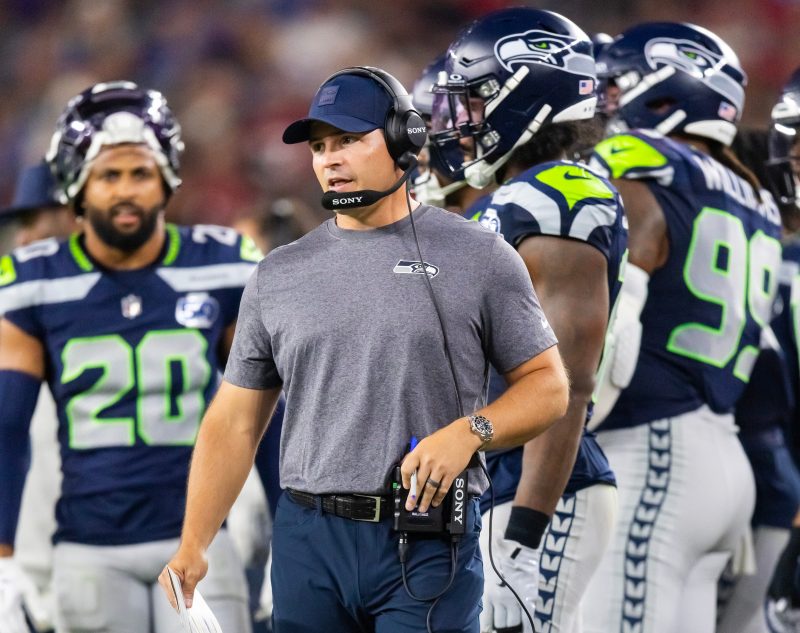
SAN JOSE, CA – By nearly any metric, the Seattle Seahawks were a success in 2024, head coach Mike Macdonald’s rookie season. They finished 10-7 – better than any of previous coach Pete Carroll’s final three years in the Pacific Northwest – and fell just a tiebreaker shy of winning the NFC West and qualifying for the playoffs.
Yet it didn’t necessarily feel like success to Macdonald, something Pro Bowl defensive lineman Leonard Williams noticed during the offseason.
“To me, as a leader, I think he showed vulnerability,” Williams told USA TODAY Sports while reflecting on Macdonald’s message to the team last spring.
“He was super open and brutally honest about where he felt like he lagged and where he felt like he needed to grow. And I think to see the head man like that, be so vulnerable, it allowed all of us to (see) we all have room to grow. And I think he created an environment where like you can really give each other advice and talk to each other without anyone taking it personally.”
And grow the Seahawks did, no longer a team that couldn’t quite overtake the Los Angeles Rams and their genius of a coach, Sean McVay, but one that finished 14-3 in the regular season – beating LA twice over the last two months on the way to the divisional crown and then a berth in Super Bowl 60 against the New England Patriots.
“Sean McVay’s one of the greatest offensive minds, and Mike Macdonald’s the greatest defensive mind in my book,” Seattle linebacker Ernest Jones IV, who’s played for both men, told USA TODAY Sports.
“And the way they’re just intentional to the details, they’re able to adjust at any moment – I think that’s what separates them. And they’re not stuck in their ways where if something else is working (better), they’ll adjust.”
Yet Macdonald’s Seahawks were able to separate from McVay’s Rams this season, thanks to a thrilling 38-37 overtime win in Week 16, followed shortly thereafter by a 31-27 triumph in the NFC championship game.
Certainly Seattle was vastly improved by the free agent signing of quarterback Sam Darnold. The team also employed the complementary football approach Macdonald craved, reliant on a dominant defense plus a balanced offense that could control the clock with an efficient passer and strong run game.
That, plus added experience in his role, allowed Macdonald to truly flourish.
“His confidence has really grown over this last year. First time being a head coach, so he didn’t know what to expect,” linebacker Uchenna Nwosu told USA TODAY Sports while referencing 2024.
“Over the year, his confidence grew, his trust in us grew, and we started all playing better. And once we were playing better, it makes it a lot easier for him to do this thing, get in his bag and call his plays.”
Yet the starting point of the Seahawks’ arc begins with the organizational decision to hire a rising defensive-minded coach like Macdonald in a division that had been dominated by offensive masterminds McVay and Kyle Shanahan of the San Francisco 49ers. And Macdonald and Co. quickly caught up, going 22-5 (including postseason) since Seattle’s Week 10 bye in 2024.
“Mike Macdonald over in the NFC West? Where it’s McVay and Shanahan? OK, we’re not gonna find another guy like that – let’s find a defensive genius who can combat it. And then the leap we saw from Year 1?” marveled NBC analyst and former NFL quarterback Chris Simms to USA TODAY Sports.
“The defense grew schematically. … All of that’s special.”
Indeed.
After finishing 11th in scoring defense in 2024, the Seahawks allowed the fewest points in the league in 2025. Their 230-point differential (playoffs included) is the fourth best this century among teams entering the Super Bowl. And Macdonald’s defense created havoc, mostly generated by its stunting front four – finishing with 180 pressures, third in the league, despite being 26th in blitz rate (not quite 20% of the time).
“This defense attacks, they simply attack,” analyst Cris Collinsworth, who will call Super Bowl 60 for NBC, told USA TODAY Sports. “The overriding theme for this team is to attack.
“It’s an exciting defense to watch. Is it the Legion of Boom? No, it’s completely different. But it’s exciting to watch.”
Yet Macdonald feels the most important change from Year 1 to Year 2 was a philosophical shift.
“You’re not waking up in the morning trying to be a players’ coach or not be a players’ coach, or ‘I want to be this type of coach,’” he told USA TODAY Sports. “Where do we want to go?”
And the answer was he wanted his team to feel more “connected,” part of the reason he laid bare his shortcomings in those offseason meetings.
“I just felt like that’s what we needed to get to,” he continued. “Tried to make all the decisions to try to create that as the core identity of our team.”
Macdonald’s boss noticed.
“He’s so intelligent. Everything he does, there’s an intent to it. He’s a real clear thinker,” Seahawks general manager John Schneider said Monday on NFL Network. “It’s really been a cool fit.
“He’s a very authentic person, and I love that about him.”
And, in addition to the players and Schneider, Macdonald’s staff noticed, too – the entire organization now just four quarters away from winning its second Lombardi Trophy.
“It’s a million things – it’s like which grain of sand makes the sandcastle?” Seahawks special teams coordinator Jay Harbaugh told USA TODAY Sports regarding the adjustments Macdonald made before this season.
“It isn’t really one thing. In my opinion, for a leader, the first real responsibility is to model the desired behavior of the group. That’s where a lot of people go wrong, especially in high-stakes, high-pressure environments, where people see through b.s. really fast. Mike’s really modeled the behavior that he wants from the team. So we just do what he does.”
Harbaugh also said the accountability and vulnerability Macdonald value has “trickled down” to the players and staff.
“It gives you permission to (acknowledge) you’re not perfect, you don’t need to pretend to be perfect,” said Harbaugh. “He’s already shown that’s an acceptable thing. I think there’s a cumulative effect of that, really just minimizing egos and increasing the collective vulnerability and accountability to just being the best that it can and not needing to protect your image or cover your tracks, that kind of thing – which you can get sometimes on bad teams.
“There’s a lot of things under that umbrella, the way he acts. That’s the leader you want to follow and do things like him and look where we are – it’s working out pretty well.”
Just ask McVay.